

The fastest way to check a collection for duplicates is a single pass that adds every element to a HashSet and stops when Add returns false.
That is O(n), and in my benchmarks the plain foreach version was the clear winner.
The LINQ Any and All variants do the same work in one line.
QuadSpinner Highlighter is an open-source Visual Studio extension that lets you highlight important objects and arbitrary texts to help you navigate your code more easily.
In this week's newsletter, we will take a look at five different ways to check if a collection contains duplicates.
I'm going to explain the idea behind each algorithm, discuss the algorithm complexity (Big O Notation), and at the end, we'll look at some benchmark results.
The five approaches for finding a duplicate will use the:
Let's see how we can implement each approach!
Check For Duplicates With ForEach Loop
The first implementation will use the foreach loop and the HashSet data structure.
Here's the code for the ContainsDuplicates method:
public bool ContainsDuplicates<T>(IEnumerable<T> enumerable)
{
   HashSet<T> set = new();

   foreach(var element in enumerable)
   {
      if (!set.Add(element))
      {
         return true;
      }
   }

   return false;
}
The idea is simple:
- Loop through the collection
- Add each element to the
HashSet - When
HashSet.Addreturns false we found a duplicate - If we loop through the entire collection there are no duplicates
In terms of algorithm complexity, this would be O(n) or linear complexity. This is because there's only one iteration through the collection.
Adding an element to a HashSet is a constant operation - O(1).
So it doesn't affect the overall complexity.
Check For Duplicates With LINQ Any
We'll combine the idea from the previous implementation of
using the HashSet and pair it with the LINQ Any
method to iterate over the collection.
Here's the implementation for the ContainsDuplicates method:
public bool ContainsDuplicates<T>(IEnumerable<T> enumerable)
{
   HashSet<T> set = new();

   return enumerable.Any(element => !set.Add(element));
}
You can see this implementation is significantly shorter.
But it works the same as the one with the foreach loop.
If any element in the collection satisfies the specified expression,
Any will short-circuit and return true.
Otherwise, it will iterate over the entire collection and return false.
We're still looking at linear complexity here, O(n).
Check For Duplicates With LINQ All
For our third implementation, we will use the opposite
of the LINQ Any method - the LINQ All method.
Here's the implementation with LINQ All:
public bool ContainsDuplicates<T>(IEnumerable<T> enumerable)
{
   HashSet<T> set = new();

   return !enumerable.All(set.Add);
}
The idea here is a little different than in the previous implementation.
All will return true if all elements in a collection
satisfy the specified expression.
If at least one element doesn't satisfy the condition -
in our case when a duplicate is found - it will short-circuit and return false.
This is still linear complexity, O(n).
Check For Duplicates With LINQ Distinct
So far, we've seen a few implementations using the HashSet data structure.
Now let's consider a different approach.
We can use the LINQ Distinct method to check for duplicates.
Here's the code for the ContainsDuplicates method:
public bool ContainsDuplicates<T>(IEnumerable<T> enumerable)
{
   return enumerable.Distinct().Count() != enumerable.Count();
}
The idea is first find the Distinct elements and Count them,
and then compare that to the number of all elements.
If the number of distinct elements is not equal to the number of all elements, we have a duplicate value.
In terms of algorithm complexity, this is still linear complexity.
But we have at least two iterations through the collection or three in the worst-case scenario.
We have one iteration for Distinct and one more
iteration for the call to Count right after that.
The last call to Count can return in constant time,
if the collection is an array or List.
Check For Duplicates With LINQ ToHashSet
For the last implementation we will use the LINQ ToHashSet method.
It takes a collection and creates a HashSet instance from it.
Here's what the ContainsDuplicates implementation looks like:
public bool ContainsDuplicates<T>(IEnumerable<T> enumerable)
{
   return enumerable.ToHashSet().Count != enumerable.Count();
}
We compare the number of elements in the HashSet to the number of elements in the collection.
If they are different, we have a duplicate value.
This is also linear complexity, O(n).
Benchmark Results
Now that we've seen our implementations let's put them to the test.
I ran the benchmark for collections of varying sizes:
- 100
- 1,000
- 10,000
Each collection contains exactly one duplicate value located somewhere around the middle of the collection.
Here are the results:
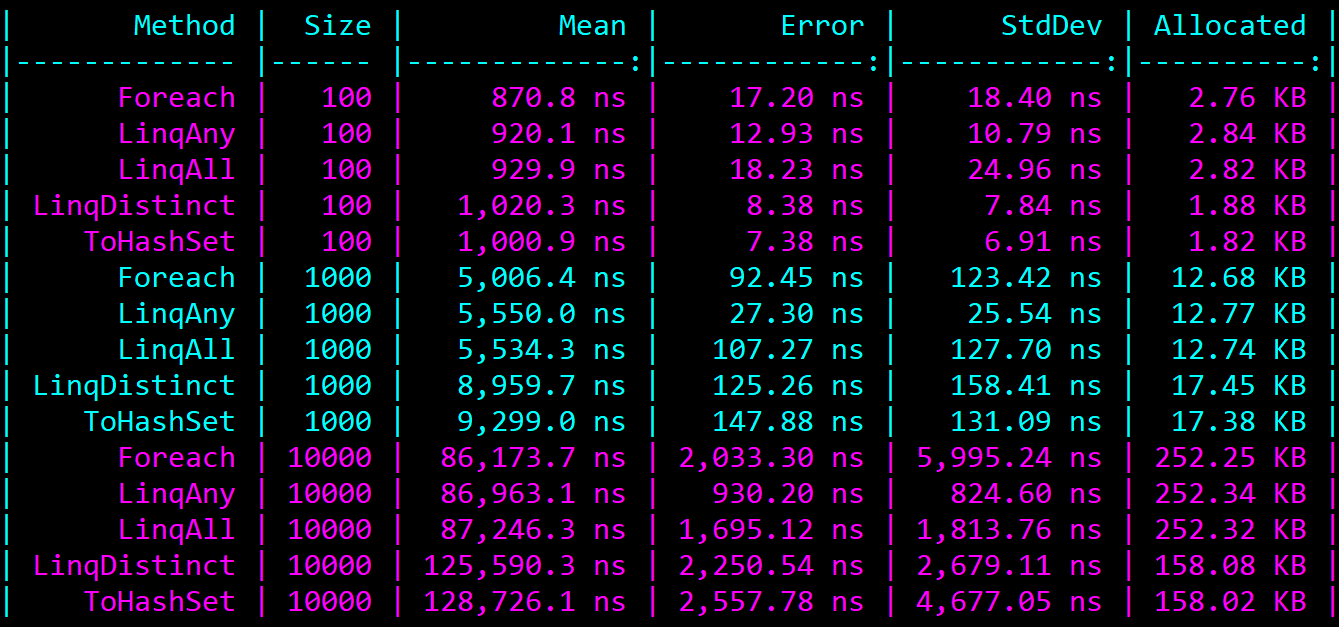
The approach using the foreach loop comes out as the clear winner in terms of performance.
However, I would lean towards using the implementations with LINQ Any or All because of their simplicity.
You can find the source code for the benchmark on my GitHub. Feel free to submit a PR with a faster implementation if you can think of one.
Frequently Asked Questions
How do you check if a collection contains duplicates in C#?
Add each element to a HashSet while iterating: when HashSet.Add returns false, you found a duplicate. You can write this as a foreach loop or more compactly with the LINQ Any or All methods. Comparing the Distinct or ToHashSet count against the total count also works.
What is the fastest way to find duplicates in a collection?
In benchmarks on collections of 100, 1,000, and 10,000 elements, each containing one duplicate near the middle, the foreach loop with a HashSet was the clear winner. The LINQ Any and All implementations are still worth considering for their simplicity.
What is the time complexity of checking for duplicates with a HashSet?
It is O(n), linear complexity: a single pass through the collection, where adding an element to a HashSet is a constant O(1) operation. The Distinct and ToHashSet approaches are also linear but iterate the collection at least twice.
How does HashSet.Add detect duplicates?
HashSet.Add returns false when the element already exists in the set. While looping over a collection and adding every element, the first false return signals a duplicate; completing the loop means every element is unique.
Is comparing Distinct and total counts a good way to check for duplicates?
It works: when the distinct count differs from the total element count, the collection has a duplicate. But it makes at least two iterations, or three in the worst case, so the single-pass HashSet approaches perform better.